The Best Fluffy Pancakes recipe you will fall in love with. Full of tips and tricks to help you make the best pancakes.

- My player tells me, “I rolled all 18s!” Should I believe these stats are genuinely random?
- What is the actual chance of a player rolling up a character with all 18s in a single set of six rolls?
- So just how dubious should you be when a player turns up at your table with a character with this amazing set of stats?
- How many rolling attempts would someone have to make to ‘reasonably’ expect to get this result at least once?
- How does someone actually calculate this stuff anyway?

I’m going to go through these questions and answer them, rigorously and show ALL my working. By the end of this article you should have a much better understanding of how these probabilities are calculated… and… whether you should believe your player… or not?!
Basic intuitions about rolling all 18s
So, straight up, looking at these stats (ignoring bonuses from ancestry/species/race/other things) you should already be able to intuit:
- Six rolls of 18 in a row is VERY unlikely (whether you are using 3d6 or 4d6 drop the lowest)
- Six rolls of 18 is, however, a thing that is possible and MIGHT occur
- The more attempts a person makes the more likely it is they might manage to roll six rolls of 18
- After many many attempts it will EVENTUALLY become more likely than not that this will occur (from here on in, we will call this ‘reasonably’ likely)
Here we are defining ‘reasonably’ likely as “it will occur at least 50% of the time”.
I love statistics, but have never really understood the specific maths very well at all.
Sooo… for you, I’ve gone through this problem very carefully, and I’m going to show you my results, showing ALL my working, every step of the way, so you can understand with me!
So if you are ready, strap on your Headband of Intellect and we’ll start at the very beginning.
How does calculating probabilities work?
Let’s start with a very simple example.
What is the probability that I will roll a 6 on a single roll of a six sided die (we’ll call this die a d6 from now on)?
We make this calculation by dividing the number of ways I can get the result I am looking for (my favorable outcomes) by the number of total outcomes that are possible (the sample space).
In this first example there is only ONE favorable outcome:
(1) 
And there are SIX possible outcomes in the total sample space:
(2) 
So,
The probability of an event E, P(E), is:
(3) 
So…
(4) 
Expressed as a percentage (the intuitive way most people think about probability), that is 17% (ish). Would you bet on a 17% chance? How much would you bet? It doesn’t really sound that likely, right? So if a player announced, “I took a d6 and rolled it once and the result was 6”, you might respond, “that was pretty lucky!”
Now here’s the question. What result would seem unsurprising, something you wouldn’t call “lucky”, but rather, “likely”…? Maybe a 50% chance… reasonable odds? That’s a coin flip. If your player said instead, “I picked up a coin and flipped it, and it came up heads”, you might respond, “so what?!” With that in mind, how many times would I need to roll that d6 to give me a 50% (a ‘reasonable’) chance of at least ONE of those rolls being a 6?
Chance of rolling at least one 6 on a d6 with multiple attempts
This is the important maths for where we are ultimately heading, so let me step you through it carefully here.
IMPORTANT THING TO NOTE:
I used to think that if the chance of rolling a 6 with a single die is  , then if I take two attempts then I have + chance of getting a 6 in one of those rolls… and thus if I try 6 times I have + + + + + = 100% chance of success, i.e it is a sure thing. This is NOT how probability works.
So how does probability work?!
We’ve already determined that the probability of getting our favorable outcome from a single d6 roll is .
That makes the chance of NOT getting the favorable outcome  .
.
You’ll see us doing this a bit in probability: since we want to know the probability of rolling at least on 6, we need to calculate the chance of getting the result we DON’T want (and then eventually minus that from 1).
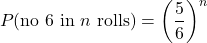
Since each roll is independent (i.e. having rolled once already has NO affect at all on the next roll I am about to make, despite what the gambler’s fallacy intuition tells you):
(5) 
(6) 
Since we are interested in that unfavorable outcome NOT happening (since “at least one” = “not none at all”) (i.e. we DO get one six in any of those single rolls) we calculate 1 minus that equation above (as promised):
(7) 
Let’s try plugging 6 into  in this equation:
(8) 
Wow! That’s a LOT less than 100%. So if I roll a d6 SIX times, I’ve still only got a 67% chance of rolling at least 1 six. Weird.
OK. But, that’s still quite a lot more than 50%. How many rolls do I actually need to take to have my greater than 50% (‘reasonable’) chance of getting at least one 6.
Let’s just plug in some different ‘s and see how we go.
(9) 
(10) 
And there you have it. If I roll a d6 THREE times, I only have a 42% chance of rolling at least one 6, but if I roll it FOUR times my odds are better than even.
So, if someone makes ONE roll of a d6 and it comes up 6, we might say, “wow, that was lucky”. But if someone rolled 4 times and got one 6, we might say, “well, that was to be expected”, because that would happen to (more than) 50% of people who made this attempt.
EXPERIMENT TIME:
Take a d6 and roll it 4 times (or roll 4d6 all at once = it doesn’t make a difference). Did you get at least one 6?
Do that again?
If you keep taking four attempts in a row, over and over, the maths says 50% of the time you will get at least ONE 6.
Does reality pan out that way for you?
NOTE: if you roll THREE or more 6s every single attempt (i.e. you achieve an 18 stat roll every time):
1) check for a magical distortion field
2) roll up a character NOW
3) go and buy a lottery ticket!
Have I still got you? Am I making any sense at all?!
Chance of rolling an 18 on 3d6
OK. Now you naturally have started to think about that 18 stat. So far, we’ve been rolling just ONE 6. To achieve an 18 we’ll be hoping to get three 6’s in a row. Try rolling 3d6 right now just a few times. How many times did you get an 18? Did it happen even ONCE?
So what IS the probability that you roll 3d6 and they ALL come up 6’s?
Back to the maths. I’m going to lay out things differently this time, in case different ways of presenting things work better for some people.
Step 1: Define the experiment
- We roll three six-sided dice.
- Each die can show a number from 1 to 6.
- Our favorable outcome is 6, 6, and 6.
Step 2: Find the total number of possible outcomes (our sample space)
- Each die has 6 possible outcomes.
- For three dice, the total number of possible outcomes is:
 , or
, or  (that is 6 sides and 3 dice).
Step 3: Identify the number of favorable outcomes
- We are interested in the event where all three dice show 6.
- That is, the result is (6, 6, 6).
- There is only one such outcome (think of the number of different ways you can turn over the three dice and have three 6s showing = this will be a useful way of thinking about things when we have four dice, later on).
Step 4: Calculate the probability
Remembering that, the probability of an event E P(E) is:
(11) 
So…
(12) 
Step 5: State the answer
The probability of rolling an 18 (that is, all three dice show 6) is  or 0.46%.
Woah, hang on, are you telling me there’s only a 0.46% chance of rolling an 18 on any single stat? That’s a LOT less than I thought it would be!
OK, so what about 4d6 drop the lowest? Maybe that’s a lot easier to get an 18?
Most people don’t roll 3d6 for stats anymore. Everyone I know rolls 4d6 drop the lowest. That probably makes it much easier to get an 18, right? Six times easier, or something? Let’s do that maths.
Calculating our sample space is just as straightforward as before:
 or
or  (the number of results available at each roll, to the power of the number of dice) =
Calculating our count of favorable outcomes is a little more difficult, and this is where my brain would have normally glazed over, so let me try and make this super clear (for the benefit of any other me’s who are out there).
So, favourable outcomes will look like four rolls, at LEAST THREE of which are 6’s.
6,6,6,1 will work for us, as will 6,6,6,2 and any other result on that 4th die = there are a total of 6 options there (including 6,6,6,6 btw)
6,6,1,6 will also work, along with the other 5 options there = there are another 6 favorable outcomes for us to add to our tally. BUT WAIT, we can’t include 6,6,6,6 because we already counted that above, so we only add 5 total options, bringing our count to 11.
I’m sure you can see a pattern here, so let’s add in
6,1,6,6 etc = another 5 results here.
AND finally
1,6,6,6 etc = another 5 results there.
So our favorable results are
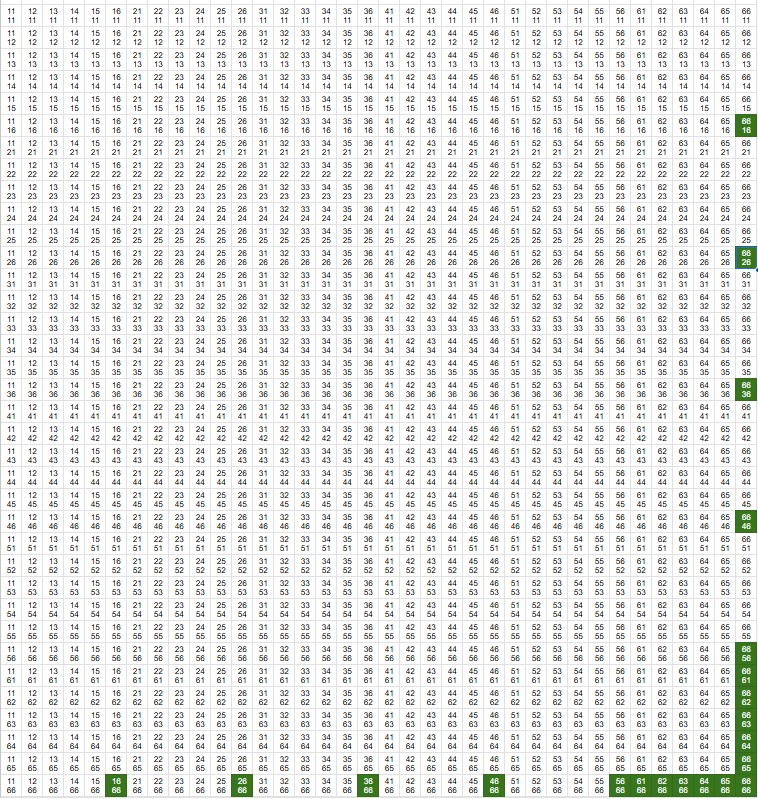
6 + 5 + 5 + 5 = 21 total favorable results.
In case you need another way of visualizing this, here is a table with ALL the actual results showing with the favorable results highlighted GREEN.
So now we simply calculate:
(13)
or…
(14) 
Wow, that’s just 1.6%?!
So every time I make a single stat roll attempt, there’s only 1.6% chance I will roll an 18?! Wow! This is btw a LOT less than 6 times our 0.46% from above.
So if a player comes to you and says, “I just rolled 4d6 drop lowest and got an 18” a perfectly reasonable response might be, “Blimey, that’s amazing! You must be stoked!” (if you happened to be Australian, like me).
Note: Once a player has rolled ALL six of their stats using 4d6 drop the lowest, the maths becomes a little more favorable… since:
So your player has just a little less than a 10% chance of rolling at least one 18 each time they roll up a full character worth of stats. So rolling a character with an 18 is more like, “yay, lucky you”, and a little less “blimey!”.
So what if a player said, “I rolled 18 on ALL my stats with just a single try!” Just how ‘lucky’ were they?
I reckon, you’re beginning to get the idea, maybe they were… nearly IMPOSSIBILY LUCKY! Let’s express the maths in yet another way.
The chance of our single event (rolling an 18 with 4d6 once with one single roll) is:
(15) 
or
(16) 
We got this from calculating:
(17) 
being 21 possible ways of getting an 18 from 1296 possible ways four d6s can land.
Now… since to find the chance of repeating a single independent result multiple times, I simply take the probability of a single independent result and raise it to the power of the number of times I am looking to repeat tha—
Hang on one moment..!
What does independent mean here?! “Why do you keep saying that?”
An example of an independent event is one where every time a result is tested, the whole system completely resets to its original state. Every time you roll the dice, you pick them all up and make a completely fresh roll. That fresh roll doesn’t know anything about what has ever come before, and what you rolled last time won’t affect what happens next. That’s what we have here.
So what does dependent mean then?! “Can you give me an example of a dependent event?”
OK! Imagine you have a bag containing 5 red tokens and 5 blue tokens (10 total).
You draw two tokens in a row, without putting the first back. What is the probability that both tokens are red?
Step 1: First Draw
Probability first token is red: 
Step 2: Second Draw (Depends on First)
If the first token was red, there are now 4 red and 5 blue left (9 tokens total).
So, the probability second token is red given the first was red: 
Step 3: Combined Probability
Multiply the probabilities (using the conditional probability for the second draw): 
Why is this dependent?
The probability of drawing a red token changes after the first draw, because the contents of the bag has changed. The second event depends on the first (not independent).
OK Back to where we were…
Since to find the chance of repeating a single independent result multiple times, I simply take the probability of a single independent result and raise it to the power of the number of times I am looking to repeat that event.
Like this:
(18) 
And we are looking to get that  result six times in a row:
(19) 
Wait for it…

… 0.0000000018%
How small is that even?!
It might help here to imagine C3PO saying,
“Oh, my. Sir, the possibility of successfully [rolling a character with all 18s] is approximately [fifty-five billion, two hundred forty-seven million, seven hundred six thousand, one hundred twenty-nine] to one!”
Grand and hopefully now unsurprising conclusion!
There you have it. When your player comes to you and says, “I rolled up a character with ALL 18s”. You can very very very very very safely say, “F#ck off! I don’t believe you!”
…
…
But… it IS possible?
Earlier in this now loooooong blog we wondered how many d6s someone would have to roll for it to be ‘reasonable’ or unsurprising that they rolled at least one 6.
Sooooo….
How many characters would that player have to roll up for you to accept it was unsurprising that at least ONE of those stats sets came up all 18s?
OK! [deep breath] Let’s calculate the number of attempts needed to have a 50% (or greater) chance of rolling at least one “all 18s” character using 4d6 drop lowest for all six stats. I’ll show every step and rearrangement.
Step 1: Restate the Problem
What is the smallest number  such that, if you roll up characters (each with six stats, 4d6 drop lowest), you have at least a 50% chance that at least one character has six 18s?
Step 2: Probability for a Single Character
From before, the probability that one character has all six stats as 18 is:  Or as a decimal:
Step 3: Probability of NO Success in ( n ) Attempts
The probability that a single stat set does not have all 18s is: 
The probability that none of the attempts succeed is: 
Step 4: Probability of AT LEAST ONE Success in ( n ) Attempts
The probability that at least one attempt succeeds is: 
Step 5: Set the Probability to 50% and Solve for ( n )
We want at least a 50% chance  or, for the threshold:
Step 6: Rearranging the Equation
becomes
Now take the natural logarithm  of both sides:
Which allows us to do this rearrangement:
And thus:
Step 7: Plug in the Numbers
Since  and
and 
Thus: 
Step 8: Final Statement
You would need to roll up approximately 38.3 billion characters (each with six stats using 4d6 drop lowest) to have a 50% chance that at least one character has all six stats as 18!
So, how should I respond when my player says they rolled a character with all 18s?!?!
Let’s say it takes 15 seconds to roll 4d6 six times (yes I experimented).
Those 38 million rolls would take 550 billion seconds, or 9 billion minutes, or 160 million hours… or… working 12 hours a day with no breaks, 221,613 days.
So…. if your play came to you and said, “Hey, I spent 600 years rolling up characters and I rolled up this one… it has all 18s for stats!”, you might quite reasonably respond… “fair enough, let’s game!”