Read the latest Syrinscape blog posts for tabletop RPG tips, Game Master and Player advice, and ideas for creating more immersive adventures.

TL;DR I made a web calculator here: syrinscape.com/which-dnd-weapon-is-best/ to help me work out which D&D weapon will do the most damage per round (on average) against which ACs.

Hi, Ben here, CEO & Creative Director of Syrinscape… but more importantly for this blog… mad keen D&D player. Like many of us, I have one most-favorite-character who I will always play… given half the chance. Mine is Kiri Rowenwood, a rapier wielding Bard. She is sassy, a bit obnoxious, sings for inspiration and never quite pays attention to plot exposition. She’s my excuse for asking, “what are we doing again?” I originally built Kiri in D&D 5th edition, but have been asked to join a new campaign, so am updating her build, starting at 2nd level for a new 5.5 game.
As I already mentioned, Kiri has always wielded a rapier. That was just part of who she was. Elegant. Precise. Graceful. Slightly smug. The whole package.
So imagine my horror when the update stripped her of proficiency with this beloved weapon. Her attack bonus dropped from +5 to +3. She still has a dagger available at her full attack bonus (including proficiency), which means… now suddenly, I have an awkward and very real question:
When should Kiri use the rapier, and when should she use the dagger?
I have some instincts. But maths is fun, and this is exactly the sort of problem where actual calculations sometimes prove more accurate than gut feeling alone.
The basic problem
What’s the actual problem here?
- The dagger hits more often (when the AC is significant), because its attack bonus is higher.
- The rapier does more damage on a hit, because it has the bigger die.
So the real question is not “which weapon is better?” but “which weapon is better against the particular AC I am targeting right now?”
That is the part that makes the maths delicious.
The weapons

Here are Kiri’s two options:
- Rapier: attack bonus +3, damage 1d8+3. (she’s adding DEX to the attack & damage roll)
- Dagger: attack bonus +5, damage 1d4+3. (additionally she’s adding proficiency to the dagger attack roll)
The dagger is more accurate. The rapier hits harder. Which one wins depends on the target AC.
Expected damage
What we need to do to actually properly compare them is to calculate expected damage per attack.
Where P(hit) is the probability of hitting a particular AC.
That is the whole trick. One part tells us how often the attack connects. The other part tells us how hard it hits when it does.
I promised to show ALL my working… so here we go!
Average damage on a hit
For dice, the average roll is the midpoint.
Where N is the number of sides on the die:
So:
That means:
So the rapier does more damage when it lands. The dagger just lands more often.
Chance to hit
In D&D (and many other d20 games), where B is my attack bonus with a weapon, and AC is the target armor class, an attack hits if:
That gives us a raw hit probability of:
But also note, in D&D:
- a natural 1 always misses,
- a natural 20 always hits.
So in practice the hit chance is clamped between 5% and 95%.
Fun notation here:
- the max section chooses which ever is greater, between 0.05 (5%) and our to-hit equation.
- the min section chooses which ever is smaller between that result and 0.95 (95%).
This is one of those lovely little bits of tabletop maths where every +1 to hit is worth about 5% accuracy. Very neat. Very tidy. Very satisfying.
Running some of those numbers we get:
| Target AC | Dagger hit chance | Rapier hit chance |
|---|---|---|
| 17 | 45% | 35% |
| 18 | 40% | 30% |
| 19 | 35% | 25% |
| 20 | 30% | 20% |
| 21 | 25% | 15% |
Interesting… this table highlights the fact that the Rapier is ALWAYS 10% less likely to hit (for all middle range ACs). That makes us think we should always be using the dagger, right?!
Rapier versus dagger
Now we need to include the damage we’ll actually achieve when we DO hit to compare the two weapons directly.
Where E is the damage we can expect (on average) per attempted attack (including hits and misses):
For the rapier:
For the dagger:
…assuming we are in the normal range where the clamp does not distort things.
Let’s add a column to our table including this damage number. This is where it gets interesting.
| Target AC | Dagger hit chance | Dagger expected damage | Rapier hit chance | Rapier expected damage |
|---|---|---|---|---|
| 17 | 45% | 2.48 | 35% | 2.63 |
| 18 | 40% | 2.20 | 30% | 2.25 |
| 19 | 35% | 1.93 | 25% | 1.88 |
| 20 | 30% | 1.65 | 20% | 1.50 |
| 21 | 25% | 1.38 | 15% | 1.13 |
The crossover point
So… when we run the numbers, the crossover lands between AC 18 & 19.
Look carefully at the table and you’ll see that:
- Against AC 18 or lower, the rapier is generally better.
- Against AC 19 or higher, the dagger is generally better.
This is exactly the kind of info I needed: not a hard “always use this” answer, but a sensible tactical breakpoint. Practically speaking, unless I am pretty sure the monster the party is fighting has a super high AC (for a 2nd level encounter) Kiri can keep her rapier out of its sheath.
And that makes perfect sense for Kiri. She does not need to throw away her rapier forever. She just needs to know when the battlefield is telling her to pick up the dagger and get a bit scrappier.
But wait…?!?! What about Critical hits?!
On a natural 20, you score a critical hit, right? That doubles the weapon dice, which means the rapier benefits more than the dagger because its die is larger. How does that effect things? Arrrrghh!
For the rapier critical damage will be:
And for the dagger:
So critical hits might slightly favor the rapier? Probably not enough to blow the whole analysis apart, but enough to nudge it in that direction even more?
So that normal damage in the table above will still occur, but 5% less often, and the higher critical damage will happen in that 5% case. Ummm… Let’s just take a look at that table with the new damage calcs in there.
| Target AC | Dagger hit chance of normal hit | Dagger hit chance of critical hit | Dagger expected damage (both types) | Rapier hit chance of normal hit | Rapier hit chance of critical hit | Rapier expected damage (both types) |
|---|---|---|---|---|---|---|
| 17 | 40% | 5% | 2.60 | 30% | 5% | 2.85 |
| 18 | 35% | 5% | 2.33 | 45% | 5% | 2.48 |
| 19 | 30% | 5% | 2.05 | 40% | 5% | 2.10 |
| 20 | 25% | 5% | 1.78 | 15% | 5% | 1.73 |
| 21 | 20% | 5% | 1.50 | 10% | 5% | 1.35 |
OK! So, wow! That shifts the result. Just by one, but a shift never-the-less.
That is one of my favorite things about this kind of maths: tiny changes can move the result just enough to matter.
So with crits included….the crossover now lands between AC 19 & 20.
Look carefully at the table and you’ll see that:
- Against AC 19 or lower, the rapier is generally better.
- Against AC 20 or higher, the dagger is generally better.
What about Advantage and disadvantage
Because D&D cannot resist making things more interesting, we also have advantage and disadvantage.
If your normal hit chance is p, then:
And with disadvantage:
So, since:
- advantage makes weapons that were already MORE accurate even MORE more better,
- and disadvantage makes inaccurate weapons even worse.
In general, advantage tends to help the higher-damage weapon a little more, because extra hits mean more opportunities to cash in that bigger die (so that will make the rapier better at even higher ACs than before). Disadvantage tends to reward the higher attack bonus, because accuracy suddenly matters a lot more (which might really knock the rapier out even at quite low ACs)…
OK… ok… this is all getting a bit much… I’m going and having a play in excel.
…
Wow, those results are really interesting!

OK… I officially give up trying to do this with equations… I’m going to make a classic web calculator… like those home loan things where you punch in the numbers and the results automatically spit out.
…
…give me a sec…
The calculator
Because all of this is much easier when you can just play with the numbers, I built a calculator page for it on the Syrinscape website:
syrinscape.com/which-dnd-weapon-is-best/
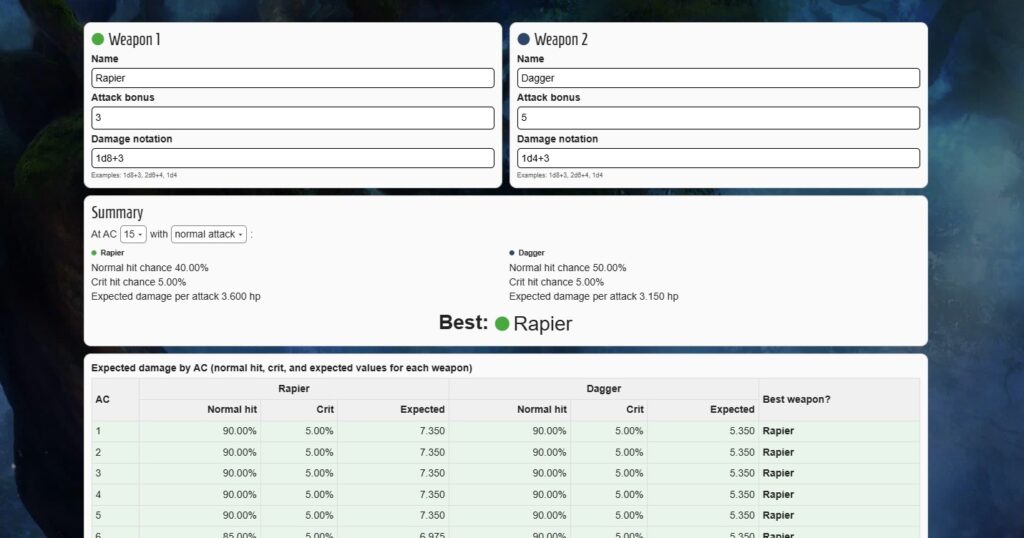
It compares the weapons across AC 1 to 30 and lets you choose:
- normal attack,
- advantage,
- disadvantage.
It shows the hit chance, crit chance, expected damage, and the best weapon for each AC. Which is exactly the sort of thing I like to have in my pocket when a character update causes a tiny weapons crisis.
Kiri is now officially ready to face just about anything and be SURE which weapon to pull out.
For Kiri we now know:
- Almost always use the rapier unless she is sure the monster has a super high AC (20 or above).
- When attacking with disadvantage almost always pull out the dagger (since that is better right down to AC 13).
Have a go with a few combos yourself!
Why I love this sort of thing
This is the kind of tabletop maths I find genuinely delightful. It is practical, but it is also just plain fun (for a maths geek like me). A weapon that feels “obviously better” on instinct is not always better in practice, and that little tension between intuition and probability is part of what makes games like D&D so satisfying.
It is also a good reminder that characters have history. Kiri’s rapier is not just a stat block entry. It is part of her identity. So when the rules change and the numbers shift under your feet, it is nice to have a clear way to decide what makes sense.
And if the answer turns out to be “use the dagger at higher AC, rapier at lower AC,” well, that is very bardic. Elegant. Flexible. Slightly dramatic. …and just how Kiri would like it.
More maths
If you enjoyed the maths in this one, you will almost certainly also enjoy my previous article where we had fun asking what the chances were of a player actually rolling all 18s is.
If you’re not a monster-slaying bard, maybe everything above sounded a bit absurd. But if you are a tabletop gamer, you know exactly why it is fun and are now keen to use this new knowledge as soon as possible.
And when you do… may you always roll high… and… look awesome doing it!
Found a maths mistake?
Want any more of these kinds of maths things?
What was your maths teachers name? And did they make you love or HATE maths?